
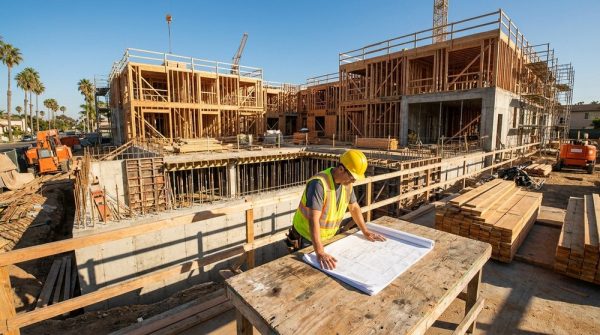
Wood-frame podium construction is the product type Inabnet builds most frequently across its San Diego projects. For developers targeting mid-density sites where garden-style construction does not deliver enough density and full concrete construction is too expensive to pencil, the podium configuration is typically the answer. But it comes with real tradeoffs worth understanding before you commit to a structural system. Here is how the wood-frame podium works — and where it earns its place in multifamily development.
What Is Wood-Frame Podium Construction?
A wood-frame podium building — sometimes called a podium apartment building or Type IIIA over Type IA construction — combines a concrete or masonry ground-level podium with wood-frame residential floors built on top. The configuration is governed by IBC Section 510, which treats the podium and the residential stories above as separate building types, allowing each to meet its own height and area allowances independently.
In practice, this means you can achieve 4–6 stories of residential — typically three to five wood-frame floors above a one-story concrete podium — where an all-wood building would max out at four stories under most code interpretations. The wood-frame podium is the primary reason mid-density ground-up multifamily remains financially viable in high-land-cost markets like San Diego.
Why This Product Type Dominates Mid-Density Multifamily
According to the National Multifamily Housing Council, wood-frame construction accounts for approximately 65% of all new multifamily units built in the United States. The podium configuration is the dominant structural approach in urban infill and high-cost suburban markets. The reason is straightforward: it is the most cost-effective way to build density.
Wood framing costs significantly less per square foot of residential floor area than structural concrete or steel. By limiting the concrete structure to the podium level — where fire separation, parking loads, or ground-floor occupancies require it — the developer captures the cost advantage of wood construction for the bulk of the building while achieving the height and density that makes the land basis work. This is why the wood-frame podium has become the default multifamily building type for mid-density sites in San Diego and comparable high-cost markets.
The Concrete Podium Level: What Goes There and Why It Matters
The podium level serves one of three primary functions: structured parking, ground-floor retail or commercial occupancy, or a shared amenity level — lobby, leasing office, fitness center, common areas. In San Diego’s coastal and transit-adjacent submarkets, structured parking podiums are common because surface parking is not viable at the densities developers need to justify land costs.
The structural design of the podium directly affects cost and schedule. A flat plate concrete podium with a transfer slab — which supports the wood-frame residential floors above — is the standard configuration, but it requires close coordination between the structural engineer and the GC during preconstruction. Podium thickness, column grid spacing, and load transfer details are design decisions made at schematic design that carry real cost consequences. Changing them after permit submission is expensive. These are not finishing decisions — they are foundational ones.
The Case For Wood-Frame Podium: When the Numbers Work
The wood-frame podium makes financial sense when three conditions align: the land basis is high enough to require density beyond what garden-style construction delivers, the pro forma can absorb the additional per-unit hard cost of the podium level, and the zoning envelope allows a 5–6 story building footprint. In San Diego’s most active development submarkets — Mission Valley, North Park, National City, Chula Vista — all three conditions regularly apply.
For construction lenders, the podium apartment building is also a known and financeable product type. Lenders who actively underwrite multifamily in San Diego have seen hundreds of podium buildings. They understand the construction sequence, the inspection milestones, and the risk profile. That familiarity reduces execution friction compared to less common structural systems — and it matters when you are trying to close a construction loan on schedule.
Talk to Inabnet’s preconstruction team to evaluate whether a wood-frame podium is the right structural system for your site and program before you commit to a design direction.
The Limitations Developers Sometimes Learn Too Late
The wood-frame podium has real constraints. First, acoustic separation between the concrete podium level and the wood-frame residential floors above requires specific detailing — particularly at the occupancy type transition. Inadequate acoustic planning shows up as tenant complaints after lease-up, which affects your renewal rate and your standing with the next equity partner you bring in.
Second, moisture management at the podium deck is critical in San Diego’s coastal climate. The interface between the concrete slab and wood framing must be properly waterproofed and ventilated. When this detail gets rushed under schedule pressure, remediation after framing is in place costs significantly more than doing it right at the podium stage. Third, wood-frame buildings in California require more seismic detailing than in non-seismic markets. Shear wall layouts, hold-down hardware, and drag strut connections add both design time and material cost — and they get flagged in special inspections when they are underdetailed.
Concrete Podium vs Wood Frame: A Practical Comparison
The three primary multifamily building types for San Diego multifamily construction in the 40–150 unit range are garden-style wood-frame, wood-frame podium, and concrete or steel mid-rise. Each has a distinct per-unit cost range, density ceiling, and financing profile.
Garden-style wood-frame runs $175,000–$265,000 per unit in hard costs but tops out at 3–4 stories. Concrete and steel mid-rise allows 6–12 stories but lands at $375,000–$525,000+ per unit and is only viable where rents and land values support it. The multifamily product type comparison in high-cost markets usually resolves the same way: the wood-frame podium is the compromise that makes the deal work when neither extreme pencils. More density than garden-style, far less cost than all-concrete construction — that trade-off is why the podium dominates.
Code and Structural Requirements for California Podium Projects
California’s building code adds requirements that do not exist in other states. Seismic detailing for wood-frame podium buildings in Seismic Design Category D — which covers most of San Diego — requires engineered shear walls, hold-downs, and drag struts that add both design time and material cost above what similar projects require in Florida or Texas. Special inspections are mandatory for the concrete podium, the shear wall framing, and the anchor connections at the podium-to-wood-frame transition.
California Title 24 energy code applies to the full building envelope and MEP system. Residential units in a wood frame multifamily San Diego podium project must meet specific insulation values, window performance ratings, and mechanical efficiency standards beyond the IRC baseline. Inabnet’s preconstruction scope includes a code compliance review before permit submission so these requirements are priced in from the start — not surfaced as surprises after the first plan check correction.
Frequently Asked Questions About Wood-Frame Podium Construction
What is the typical height for a wood-frame podium building in San Diego?
Most wood-frame podium buildings in San Diego range from 4 to 6 stories total — one concrete podium level plus 3–5 wood-frame residential floors. The exact height and allowable area depend on the construction type classification under the California Building Code, occupancy type, and sprinkler system design. A licensed structural engineer’s IBC Section 510 analysis will determine the maximum configuration for your project.
How does wood-frame podium compare to garden-style construction on cost?
Moving from garden-style wood-frame to a wood-frame podium typically adds $55,000–$90,000 per unit in hard costs. That step up is justified when the additional density the podium enables — and the associated revenue — offsets the per-unit cost increase. Confirming whether the product type switch improves or hurts your return requires a site-specific density yield analysis and realistic rent underwriting.
What is the construction schedule for a wood-frame podium project in San Diego?
Construction for a 40–80 unit wood-frame podium in San Diego typically runs 18–26 months from permit approval to certificate of occupancy. Permit processing — including any discretionary review — can add 6–18 months depending on jurisdiction and project complexity. Total development timeline from land control to lease-up is generally 36–48 months for a mid-density project.
What permits are needed for a wood-frame podium project in San Diego?
A ground-up multifamily project in San Diego requires building permits, grading permits, and mandatory engineering special inspections for concrete, structural connections, and high-strength fastener installations. Projects above certain size thresholds or within specific zoning categories also require discretionary review through the City of San Diego Development Services Department. Projects requiring a public hearing should budget 12–18 months for entitlement.
Ready to Get Started?
If you are evaluating a wood-frame podium project in San Diego and need early cost guidance and a structural system review, Inabnet can take you through preconstruction before you commit to a design direction.