
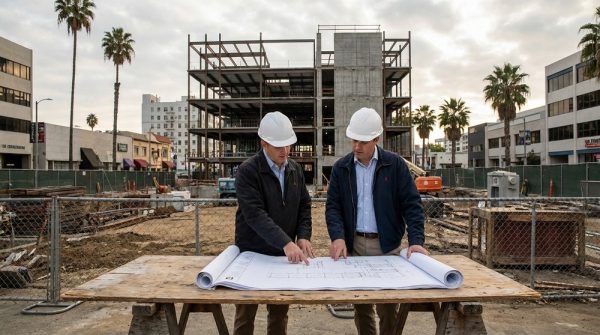
Most multifamily projects that go over budget or fall behind schedule do not fail during construction. They fail before a single shovel hits the ground. The multifamily preconstruction process is where project outcomes are actually set — and it is the phase most developers underestimate until they have learned it the hard way.
Inabnet is a multifamily general contractor working in San Diego. Every project we take on starts with a structured preconstruction phase because we have seen what happens to ground-up apartment developments that skip it: bloated change orders, blown carry costs, and lenders asking uncomfortable questions at the worst possible time.
Here is a direct breakdown of what preconstruction actually is, what it delivers, and why it is the most important work a GC does on your project.
What Is Preconstruction in Multifamily Development?
Preconstruction is the planning and analysis phase that occurs after a developer has a site under contract but before vertical construction begins. A qualified GC uses this window to build cost certainty, identify design problems, secure subcontractor pricing, and align the project scope with the developer’s proforma — before field work locks in decisions that cost five figures to reverse.
What is preconstruction multifamily? At its core, it is the phase where your GC either protects your budget or exposes it. The work is not glamorous: it involves detailed quantity takeoffs, early trade partner engagement, design review for constructability, and hard conversations about scope that developers sometimes do not want to have until they are forced to by a change order in month eight.
On a well-run project, preconstruction produces a GMP (Guaranteed Maximum Price) contract or a reliable cost model with documented assumptions. On a poorly-run project, it gets skipped in favor of a faster start — and the developer pays for that speed in the field.
The Core Deliverables of a Multifamily Preconstruction Process
Not all preconstruction is equal. Here is what a thorough process actually produces:
- Conceptual and schematic cost estimates: Early-stage pricing based on square footage, unit count, and building type (wood-frame podium, garden-style, urban infill). These benchmarks allow developers to test proforma assumptions before committing to full design fees.
- Design review for constructability: The GC reviews architectural and structural drawings for conflicts, ambiguities, and scope gaps that will become change orders if not resolved before construction documents are issued. This is where experienced GCs earn their fee before the project starts.
- Subcontractor bidding and buyout strategy: Early trade partner engagement locks in pricing for long-lead items — structural steel, MEP systems, elevator packages — before market escalation or supply chain delays affect your budget. A GC with a vetted subcontractor network in each market moves faster and with more pricing confidence.
- Schedule development: A realistic construction timeline built around permit lead times, inspection sequences, and subcontractor availability specific to San Diego — local timelines should never be built from generic national benchmarks.
- Multifamily construction cost modeling: A line-item budget tied to actual subcontractor pricing rather than industry averages. This is the number your lender underwrites against. It needs to be defensible, documented, and built on real data.
Why Preconstruction Services Apartment Development Actually Needs
There is a version of preconstruction that is primarily administrative — a GC fills out some forms, provides a ballpark number, and gets out of the way until permits are issued. That version does not protect your project.
The preconstruction services apartment development actually requires is collaborative and adversarial at the same time. Your GC should be pushing back on design decisions that add cost without adding value. They should be questioning finish specifications that are inconsistent with comparable rents. They should be flagging permit items that will add six weeks to your schedule if you do not address them now. That is the version worth paying for.
According to the National Multifamily Housing Council, construction costs for new apartment projects rose an average of 14% between 2021 and 2023 — much of that absorbed in the field through change orders and material escalation clauses that could have been anticipated during preconstruction. Developers who had a disciplined preconstruction phase and locked in buyouts early absorbed far less of that escalation than those who started construction with loose pricing.
If you are working with a multifamily general contractor who is not pushing for a structured preconstruction phase, that is a red flag about how they will manage your project in the field.
How Preconstruction Prevents the Problems Developers Fear Most
Change orders. Schedule delays. Lender draw disputes. These are the outcomes developers lose sleep over, and all three are substantially more likely on projects that skip or rush preconstruction.
Change orders originate from three places: incomplete design documents, scope gaps that were not caught before construction started, and unforeseen field conditions. The first two are entirely preventable during preconstruction. A GC who reads the drawings carefully before the project starts — and who has built the same building type in the same market — will catch most of these issues before they become field problems.
Schedule delays follow the same logic. A missed permit item or a long-lead material that was not ordered early enough can push a delivery date by months, which triggers construction loan extension fees and delays lease-up income. Preconstruction is where those timing risks get identified and mitigated — not discovered in month six.
Talk to Our Team about how Inabnet’s preconstruction process is structured for each of our three markets.
What Multifamily GC Preconstruction Services in San Diego Look Like in Practice
Multifamily GC preconstruction services San Diego require local knowledge that no national template delivers. San Diego’s permitting environment — particularly for urban infill and podium-style developments — involves city review timelines, coastal commission considerations, and fire-life-safety requirements that directly affect both cost and schedule.
A GC doing preconstruction in San Diego should be pulling permit lead times for the specific jurisdiction, not using statewide averages. They should know which MEP subcontractors have the fastest inspection turnaround. They should have a realistic view of concrete and framing labor pricing in the current local market — not numbers lifted from a national database.
Preconstruction planning for ground-up construction in San Diego requires city-specific data, not generic benchmarks. Inabnet delivers pre-construction services for multifamily projects across San Diego, Austin and Tampa — from conceptual estimating and design review through subcontractor buyout and permit strategy.
The Connection Between Preconstruction and Your Proforma
Your proforma is only as good as the cost data underneath it. If your construction budget is a rough estimate with a 15% contingency attached, your proforma has a 15% variable — and sophisticated equity partners and lenders will see that immediately.
A well-executed multifamily preconstruction process produces a construction budget that is based on actual subcontractor pricing, not allowances. That distinction matters at the capital stack level. A lender reviewing two competing projects — one with a fully bought-out preconstruction estimate and one with a conceptual number — will underwrite the first one more favorably, because the risk is documented and contained.
Inabnet’s consulting and preconstruction services are structured to give developers the cost certainty they need to close financing, move forward with confidence, and hand the lender a budget they can defend.
How to Evaluate a GC’s Preconstruction Capability
Not every GC approaches preconstruction the same way. When you are evaluating general contractors for a ground-up multifamily project, here is what to ask about preconstruction specifically:
Ask how they build their cost estimates — are they using historical square-foot averages or actual subcontractor pricing from current bids? Ask what their design review process looks like and how many issues they typically flag during a typical set of construction documents. Ask who runs preconstruction on their team — is it a dedicated preconstruction manager or a project manager handling it as a secondary responsibility?
The answers reveal whether preconstruction is a core competency or a box to check. A GC who can walk you through exactly how they protect your budget before construction starts is demonstrating the operational discipline that will define how they run your project in the field.
Frequently Asked Questions About Multifamily Preconstruction
What is included in a preconstruction agreement?
A preconstruction agreement typically covers conceptual estimating, design review, subcontractor solicitation and bidding, schedule development, and cost modeling. Some agreements include site logistics planning and permit application support. The scope should be defined clearly in writing, with deliverables tied to specific milestones in the project development timeline.
How long does preconstruction take for a multifamily project?
For a typical ground-up multifamily project — 50 to 200 units — preconstruction runs four to eight weeks depending on design completeness and the GC’s subcontractor pipeline. Projects with incomplete drawings or complex entitlement conditions take longer. Rushing this phase to accelerate start of construction is one of the most common and expensive mistakes developers make.
Does preconstruction guarantee the final construction cost?
A thorough preconstruction process substantially reduces cost variance, but it does not eliminate it entirely. A GMP contract — Guaranteed Maximum Price — is the mechanism that converts a preconstruction estimate into a contractual ceiling. Not all projects use GMP; some use lump sum or cost-plus structures. Your GC should be able to explain the tradeoffs between each contract type and recommend the structure that fits your project’s risk profile.
Can preconstruction services be used without hiring the GC for construction?
Yes. Some developers hire a GC to run preconstruction only, then rebid the construction contract. This is more common on large institutional projects. For mid-market multifamily ($5M–$30M), most developers work with the same GC through preconstruction and construction — the continuity reduces transition risk and maintains budget accountability throughout the project.
What do pre-construction services for multifamily projects include?
A full multifamily preconstruction scope covers conceptual and detailed estimating, constructability and design review, subcontractor solicitation and buyout, permit and entitlement strategy, site logistics planning, value engineering, and a milestone-level construction schedule. On Inabnet projects these run through our entitlement and pre-construction team, so permit strategy and cost modelling are handled by the same people who will build the project.
When should a developer bring a GC into preconstruction?
At schematic design, or as soon as a site is under contract. Waiting until construction documents are complete removes most of the leverage preconstruction offers — by then the drawings are set and the only remaining cost lever is scope reduction. Developers who engage a general contractor early get constructability input while changes are still cheap to make.
How does preconstruction affect construction financing?
Lenders underwrite documented budgets more favourably than conceptual ones, and the preconstruction estimate becomes the basis for the draw schedule the lender funds against. Understanding how a construction draw schedule works before closing avoids funding gaps once construction starts.
Ready to Get Started?
If you are planning a ground-up multifamily project in San Diego, the time to engage a GC is before your drawings are finalized — not after. Inabnet’s preconstruction process is designed to protect your budget from the first estimate to the last draw.
Talk to Our Team or call us at (833) 390-4602.